Turtles Tortoises and Terrapins a Natural History Review
Turtles are the reptile everybody loves. At the very least appreciated for their hard-shell adaptation, the way they quietly survive in ponds, rivers, oceans, islands, forests, fifty-fifty, for a few species, deserts, and, if you are of a certain age, their cultural depiction every bit ninja warriors. Birders are always happy to see a turtle or tortoise, and at that place are times of the year when my social media feeds are sprinkled with photos of turtles beings removed from roads or crawling to land to lay eggs. I happen to be particularly fond of turtles considering my family has taken intendance of a pocket-size box turtle for 30 years (beware–turtles are extremely depression-maintenance pets but will outlast your child'south youth and probably your life). I've happily photographed turtles and tortoises on my travels, from softshell turtles laying in the mud in Florida to behemothic tortoises basking in the sun in the Galapagos.
Still, I had no idea that there are more than 350 species of turtles, tortoises, and terrapins currently existing around the world, or that in that location is a record of extinction of over 700 species. Or that tortoises and terrapins are considered part of the turtle family unit. Or that a turtle's sex is determined by the temperature of the egg during incubation (except for softshells and a few other species whose sex is determined past good former chromosomes). Or that creatures whose concrete appearance is defined and limited by a difficult, bony beat could nowadays such a dizzying variety of shapes and patterns–domed or flat or crazily ridged carapaces (the upper part of the vanquish) busy with spots or complex patterning or simply a polish monotonic shiny brown, short or long necks that may retract vertically or sideways, soft bodies sporting intricate markings, faces that expect inquisitive, mean, or similar a piece of wood (take a look at the Matamata of northern South America). This I all learned past reading and browsing through Turtles of the World: A Guide To Every Family , by Jeffrey Eastward. Lovich and Whit Gibbons.
Turtles of the World is a heavily illustrated introduction to turtle/tortoise/terrapin life around the world, organized taxonomically and flavored with expertise, wonder, and concern. The introductory sections nicely summarize turtle evolution, systematics, and taxonomy; anatomy and physiology; global and regional distribution; behavior, including feeding and reproduction; growth and longevity (this is an lodge with famous large and long-living members); ecological and cultural importance; and conservation. Though this is a book written for non-scientists, some of this material may initially intimidate readers. The chapters on evolution and anatomy are peculiarly heavy in the use of scientific names and terms and require careful reading. Information technology's useful to remember the names of the two suborders of Testudines (the reptile order that includes all turtles): Cryptodira (turtles that retract their heads vertically and sea turtles–most of the turtles in the earth) and Pleurodirans (turtles that retract their heads sideways). Thankfully, in that location is a refreshing lack of business for the taxonomic controversies that are apparently as rife in the turtle world as they are in the bird world. I particularly liked the authors' annotate, "We volition leave for academic consideration the issue of how to shift public perception regarding the esoteric conundrum that birds should be incorporated into the Reptilia as 'modernistic dinosaurs'" (p. 13). I don't know if I agree with the authors' disdain, simply I empathise with their want for simplicity.
Later introductory chapters are easier reading and educational, particularly if you know picayune nigh turtles. Turtles play meaning ecological roles in their habitats: seed dispersal and germination of plant species, burrowing that results in mixing of soil layers and employ of burrows past other species, energy transfer of minerals and nutrients from h2o to land. This culture chapter is necessarily cursory just did brand me wish for a reptile equivalent of Birds and People, where I could read more nearly turtle imagery in organized religion and literature. It was fun to see both Yertle the Turtle and Teenage Mutant Ninja Turtles cited equally examples of cultural imagery.
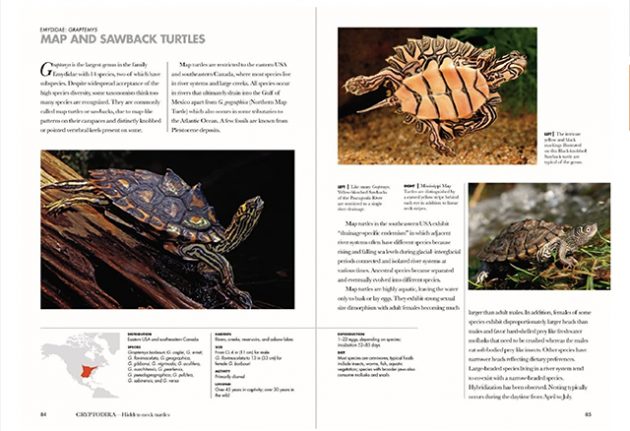
©2021 text by Jeffrey E. Lovich & Whit Gibbons, ©2021 Quarto Publishing plc, p. 84 © Getty Images/Resschke, p. 85T © Ardea/Danita Delamont/David Northcott, p. 85b Alamay Images/Juniors Bildarchiv GmbH
The majority of the volume covers the environmental, beliefs, and distribution of the 14 families of living turtles. There are 95 genera and roughly 350 species of turtles, tortoises, and terrapins, and it's of import to note that this volume focuses on families and to some extent genera. The accounts are organized by the ii suborders and then past family. Introductory pages for each group summarize the subgroups (suborder pages summarize the families, family pages summarize the genera), describing where these particular turtles are most probable to be constitute and their shared anatomical features and behavioral characteristics. Family introductory pages list the facts: distribution by continent, names of genera, habitats, size ranges, typical activities, clutch size, reproductive timing and egg clarification, and diet–herbivorous, cannibal, omnivorous, and typical food items. All family accounts are two pages in length, ane folio of text and one full page displaying a cute photographic close-up of a typical family member.
Genera accounts–descriptions of each genus–are like in style to the family unit descriptions. One or ii pages present both summary facts and interesting details about selected species, handsome illustrations, and a box of facts on distribution, names of species, habitats, size range, life span, action (diurnal, nocturnal, or crepuscular; hibernation; aquatic), reproduction, diet. The fact box also includes a pocket-size distribution map showing where the species in the grouping are constitute, highlighted in red. Although some species are illustrated and described, this book does not utilise a shut species lens, its purpose is to innovate readers to worldwide diversity, non identification. I was hoping that at that place would at to the lowest degree be a species list in the Appendix, only no, seekers of this taxonomic data must resort to other sources.
The photographs are eye-catching and one of the best parts of the book. Large, abrupt, brightly printed, they show turtles in close-up, and in habitat. There are more shut-up than habitat photos, which is understandable since many turtles tend to get lost in longer and fifty-fifty medium shots and the close-ups show off their unique beauty. The photos were gathered from a long listing of professional person photographers and photographic agencies, listed in the back. I do take i quibble: a disconnect between the names used in the text and the captions. The text mostly uses scientific names for species, sometimes giving both common and scientific names but mostly scientific names. The captions use common names. And so, you're not ever sure if the text is referring to the turtle in the epitome.
Organizationally, this book is less of a guide and more than of a browse, and it's puzzling considering I don't think it would have price the authors or book packagers a lot of time and existent estate (i.due east., pages) to improve its usability. Though it is marketed as a "Guide to Every Family" there is no tabular array of contents to the families, just listings of the introductory pages for each suborder. The back-of-the-book textile gets more detailed treatment in the table of contents than the core of the book! The genera accounts and family description pages are notated at the pinnacle and bottom of the page with suborder names (bottom of the page) and family and genus names (top of the page), but this is of limited help to the novice naturalist, for whom the book is intended. For example, the pages pictured above of "Map and Sawback Turtles" (pp. 84-85) tell you lot at the bottom of the page that these turtles are in the "Cryptodira–Hidden-neck turtles" suborder and at the height of the page that they are in the Emydidae family and Graptemys genus. While that may be helpful to readers trying to place the turtles within the whole of the earth of turtles and tortoises, it is of little assistance to someone opening up the volume and searching for Map Turtles. Fortunately, the index does incorporate an entry for "map turtles," though it doesn't differentiate between pages where the species is talked nigh in the Introduction and its genus business relationship, nor is in that location a cross-reference to the scientific genus name.
Turtles of the Earth: A Guide to Every Familywas conceived and produced by The Quarto Group, a book packaging company headquartered in London. Information technology's office of a series published by Princeton University Printing that includes Spiders of the World: A Natural History and Lizards of the World: A Guide to Every Family unit, each book written past experts and all sharing a highly illustrative, visually professional person design format. I mention this considering I would similar to see more attending paid to the usability attribute of books like this, written to impart authoritative, scientific information to lay people. It seems to me that there is more attention paid to analogy and design, making things pretty and marketable, than to ways people may actually use the books.
On the positive side, authors Jeffrey E. Lovich and Whit Gibbons bring decades of research and feel to this book. Dr. Lovich is a government scientist, Research Ecologist and Co-Deputy Chief, Terrestrial Ecosystems Drylands Branch, Southwest Biological Science Center, U.South. Geological Survey. He has studied the ecology of turtles, amidst other ecological subjects, for over thirty years and has discovered and named 4 turtle species. He has written several books, including Turtles of the United states of america and Canada, 2d ed., (with Carl H. Ernst, Johns Hopkins Univ. Printing, 2009). Dr. Whit Gibbons is a well-known herpetologist, Professor Emeritus of Ecology, University of Georgia, and former Head of the Environmental Outreach and Educational activity program at the Savannah River Ecology Laboratory (SREL). He'due south written and edited over 25 books and numerous scientific papers on frogs, snakes, salamanders, general ecology, and, yes, turtles, and has even had a turtle named after him.
The authors' goal in writing this book is fabricated clear in the opening pages, they want to "increment appreciation for these successful creatures, largely unchanged since the mists of time, and aggrandize awareness of their plight in the modern world" (p. vii). Conservation is a major thread that runs throughout the volume. Although the plight of Galapagos Tortoises and ocean turtle species have been well publicized, nigh of us probably presume that nigh turtle species are not in trouble. They just look and so content and stable! This of course is not true. A recent article past a big group of scientists, including the authors, states that "more than one-half of the 360 living species and 482 total taxa (species and subspecies combined) are threatened with extinction. This places chelonians among the groups with the highest extinction risk of any sizeable vertebrate group." * The introductory department on conservation in Turtles of the World cites the reasons: the usual habitat loss due to development and pollution, exploitation past the international pet trade, and too, perhaps unique to turtles and tortoises, use by some populations for traditional medicines and food. The text points out genera and species that are endangered from some or all of these problems and it is a constant wake-upwards call. I just wish we had that tabular array of species in the Appendix, where we could find the IUCN (International Union for Conservation of Nature) rating. For now, you can bank check the IUCN website under the taxonomic name Testudines.
Turtles of the Earth: A Guide to Every Family unitis a fun, informative, highly readable introduction to the biodiversity of turtles effectually the world. There is a lot of information here, and it's a pleasure to look at and read, only information technology's difficult to discover specific turtle genera or species considering information technology lacks a complete tabular array of contents. The index is helpful, but would have worked improve with cross-references, bolding of genera account sections, and more complete indexing of common and scientific names. The volume would as well have benefitted from additional textile on species. Naturalists interested in learning near turtles may also want to consider the older Turtles of the World by Franck Bonin, Bernard Devaux, Alain Dupré , translated from the French by Peter C.H. Pritchard (Johns Hopkins Univ. Press, 2006) or Ernst and Lovich's text on turtles of North America, cited higher up. (These are included in a short list of books and articles in the book'southward appendix.) Both these titles, however, are very expensive. Turtles of the World: A Guide to Every Familyis a reasonably priced volume with the advantage of crisp, clean design and beautifully produced photographs, making it a volume for families likewise as a guide to families. As a turtle lover and possessor, it gave me more appreciation for the importance of these creatures in so many ecological systems, for their unique beauty, their survival adaptations, and an interest in contributing to their continued existence.
* "Turtles and tortoises are in trouble,"CB Stanford, et al.Electric current Biological science thirty (12), R721-R735, https://world wide web.sciencedirect.com/science/commodity/pii/S0960982220306369.
Turtles of the Globe: A Guide to Every Family
by Jeffrey E. Lovich & Whit Gibbons
Princeton University Press, Dec. 2021
Hardcover, 240 pp.; six.75 x 9.38 in.
ISBN-10 069122322X; ISBN-13 978-0691223223
$29.95 (discount from the usual sources)
Source: https://www.10000birds.com/turtles-of-the-world-a-guide-to-every-family-a-book-review-by-a-turtle-lover.htm
0 Response to "Turtles Tortoises and Terrapins a Natural History Review"
Post a Comment